
IT cost reduction for hospitals, medical groups, and healthcare organizations.
Healthcare technology spend has its own shape. EHR licensing structures don’t look like other SaaS deals. Medical telecom carries regulatory weight that consumer telecom doesn’t. Multi-location practices accumulate vendor relationships that nobody has ever consolidated. Behavioral health, dental, and ambulatory practices each have their own technology cost patterns. Unravyl’s healthcare work brings vendor-neutral cost reduction across these patterns, with awareness of the compliance constraints that shape healthcare IT decisions.
The cost categories that matter most in healthcare.
EHR and clinical software cost optimization
Electronic health record systems are typically the largest single technology expense in healthcare organizations. We help clients evaluate EHR contract terms, renewal pricing, module licensing, and add-on costs against current market benchmarks. We don’t replace EHR systems — that’s a clinical and operational decision well beyond our scope — but we negotiate the contracts.
Medical telecom and connectivity
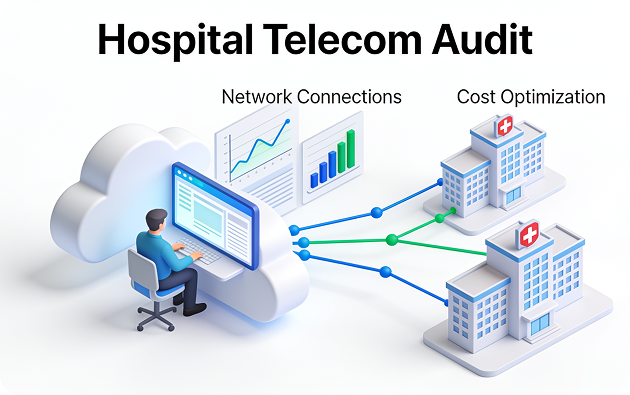
Voice, internet circuits, and network connectivity across hospital systems, multi-location medical groups, and clinical facilities. Healthcare environments often have legacy telecom relationships dating back decades, with service tied to specific clinical workflows that aren’t documented anywhere.
Mobile programs for clinical staff
Mobile device management for clinical staff has different requirements than typical corporate mobile programs. Device sharing across shifts, BYOD policy in clinical environments, and integration with clinical applications all affect the right program structure.
Cloud and software for non-clinical operations
Healthcare organizations run the same back-office software as any business — finance, HR, scheduling, billing, supply chain. These categories often produce the most accessible cost reduction opportunities because they’re not tangled with clinical workflows.
Medical device and IT asset management
Hospital systems and medical groups carry significant IT asset inventories alongside their clinical device fleets. The IT asset work focuses on the non-medical-device portion — laptops, workstations, networking, peripherals, and the lifecycle management around them.
Vendor contracts across the supply chain
Healthcare runs on vendor relationships — supply, medical devices, clinical software, telecom, cleaning services, food services, waste management. We focus on the technology and operational categories where vendor-neutral negotiation expertise produces results.
Patterns we see across healthcare environments.

Legacy telecom services billing past their use case — Medical telecom relationships often date back decades. Voice trunks, fax lines, and legacy services tied to specific clinical workflows accumulate without consistent review. Hospital systems with 50+ locations frequently have material billing for services tied to closed facilities or replaced workflows.
EHR contract terms that no longer reflect operational reality — Provider counts, module licensing, and add-on tier pricing structured in the original contract often don’t reflect current operational structure — especially after mergers, divestitures, or service line changes.
Mobile programs without clinical workflow alignment — Mobile devices issued uniformly to clinical staff regardless of role or shift pattern. Pooled data plans sized for peak rather than actual use. Lines for traveling physicians, locums, and per-diem staff that remain active long past their engagement.
SaaS sprawl from departmental procurement — Clinical departments, business departments, and individual practices procuring SaaS tools independently. The same scheduling, communication, or workflow tool purchased multiple times across the organization.
IT asset records that lag clinical change — Locations open and close. Service lines change. Clinical staff turnover is high in many segments. Asset records typically lag operational change by 12–24 months.
Vendor consolidation opportunities across multi-location practices — Medical groups that grew by acquisition often inherited each acquired practice’s vendor relationships — multiple ISPs, multiple voice providers, multiple SaaS subscriptions for the same function — without centralized consolidation.
What’s different about working in healthcare.
HIPAA and PHI protection
We work with awareness of HIPAA constraints. Our engagement scope typically does not require access to PHI — cost reduction work focuses on financial, contractual, and operational data rather than patient data. When access patterns intersect with PHI, we structure the engagement to comply with HIPAA standards and your existing BAA framework.
Clinical workflow protection
Cost reduction recommendations are evaluated against clinical workflow impact. We don’t recommend changes that disrupt clinical care to capture financial savings. When tradeoffs exist between cost and clinical workflow, we surface the tradeoff clearly and defer to clinical leadership on the decision.
Multi-entity complexity
Healthcare organizations often have complex entity structures — hospital systems with multiple affiliated practices, medical groups with affiliated specialty clinics, behavioral health networks with multiple legal entities. Our engagement structure accommodates this complexity, with cost analysis at both the entity and consolidated levels.
Regulatory contract terms
Healthcare vendor contracts often include compliance terms (HIPAA BAA provisions, regulatory data handling, reporting obligations) that aren’t typically part of corporate contracts. We negotiate within these constraints rather than against them.
Where we have engagement experience.

Hospital systems — single-facility hospitals through multi-state health systems
Medical groups — independent practices and groups affiliated with larger systems
Behavioral health — outpatient and residential behavioral health practices
Dental practices — single-location and DSOs (dental service organizations)
Ambulatory and specialty — surgical centers, imaging, and specialty practices
Senior care — skilled nursing, assisted living, and memory care operators
The methodology is consistent across segments; the specific cost patterns differ significantly.
Frequently Asked Questions
Do you need access to patient data for cost reduction work?
We can structure contingent fees for specific scopes, but our default is fixed-scope or project-based pricing. We've found that percentage-of-savings billing creates incentive distortions — it encourages firms to push for shortest-term savings rather than long-term value, and it can create conflicts when the right negotiated outcome isn't the largest dollar savings. Most clients prefer transparent fixed pricing.
Will you sign a BAA?
Yes, when the engagement scope requires it. Most cost reduction engagements don’t, but if our scope brings us into systems where PHI is present, we execute BAAs as a standard part of engagement setup.
Do you replace our EHR?
No. EHR system selection is a clinical and operational decision well beyond our scope. We negotiate EHR contracts, review module licensing, and evaluate add-on costs against benchmarks — but we don’t recommend EHR replacement.
Can you work with smaller medical practices?
Yes, with the same caveats as for any small business. Practices below approximately $5M in revenue may find that the structured assessment cost exceeds the savings opportunity unless there’s a specific catalyst — a large EHR renewal, a multi-location consolidation, or a vendor consolidation opportunity.
What about Stark Law and Anti-Kickback compliance?
We’re not a healthcare regulatory law firm and don’t provide legal advice on Stark or AKS compliance. Our vendor-neutral structure (no commissions, no resale relationships, no kickbacks) is designed to avoid creating compliance complications in the work we do, but specific compliance questions should be reviewed by your healthcare regulatory counsel.
Do you have experience with rural and critical access hospitals?
Yes. Rural and critical access hospitals have distinct cost patterns — limited vendor competition, legacy infrastructure, smaller IT teams — that affect the work. We have engagement experience in this segment.
How do healthcare engagement timelines compare to other industries?
Similar. A focused Technology Spend Review runs 4–6 weeks in healthcare as in other industries. Multi-category engagements with execution support typically run 4–9 months. The data collection phase may take longer when records are distributed across multiple entities or systems, which is more common in healthcare than in some industries.